
Why Cancún Is Becoming a Top Retirement Destination: Everything Retirees Need to Know in 2026
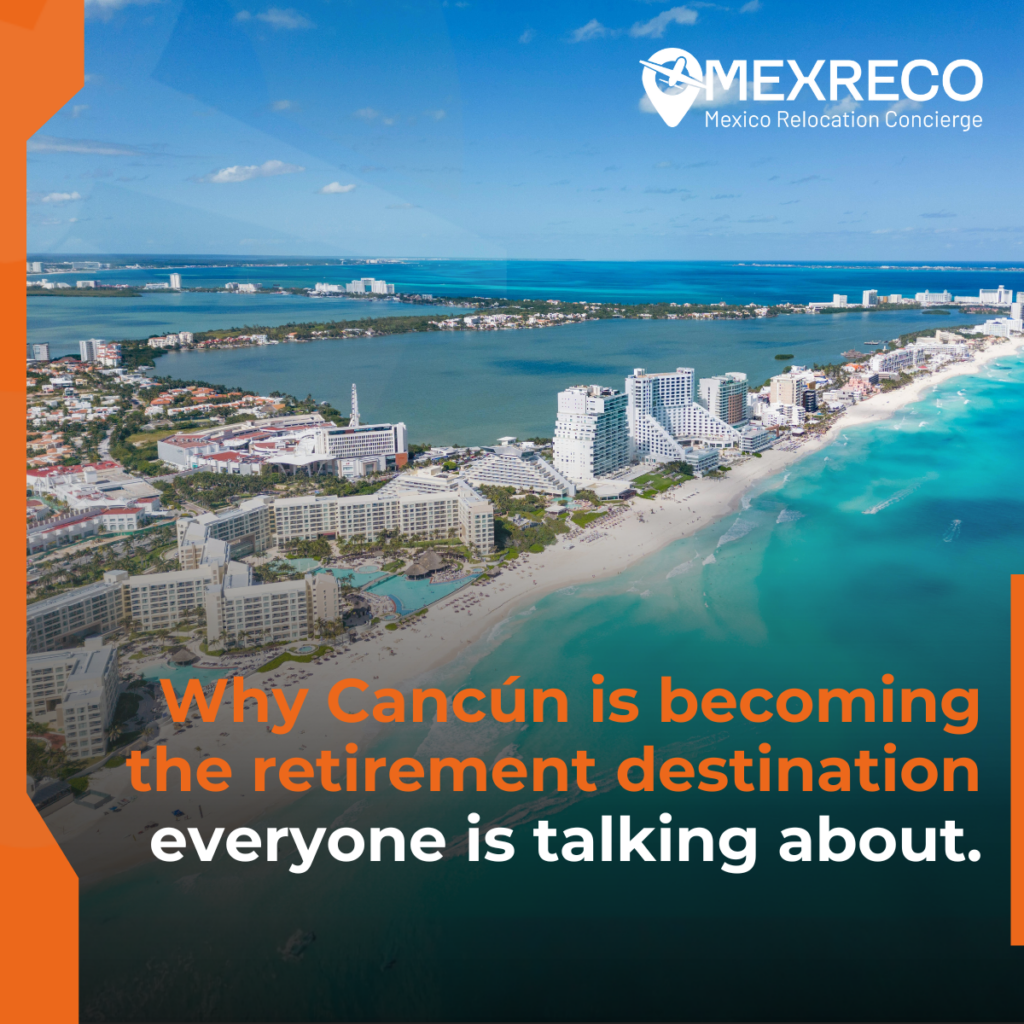
Something significant has happened to Cancún over the past decade. The city that was once synonymous with spring break and all-inclusive resorts has quietly transformed into one of the most sought-after retirement destinations in the Western Hemisphere.
The numbers reflect it. Quintana Roo — the state where Cancún is located — is home to over 40,000 foreign-born residents, with Americans and Canadians representing the largest groups. International retirement publications and financial advisors have taken notice, with Cancún appearing regularly on “best places to retire abroad” lists alongside destinations like Costa Rica, Portugal and Thailand.
But unlike a trend driven by buzz, this one is driven by substance. In this article, we’ll walk through exactly what’s drawing retirees to Cancún — and what they need to know before making the move.
The Numbers: How Many Retirees Are Already in Cancún? The Numbers: How Many Retirees Are Already in Cancún?
Mexico as a whole is home to one of the largest communities of American expats outside the US — with estimates ranging from 700,000 to over 1 million US citizens living full or part-time in the country. Within that community, Quintana Roo has emerged as a particular concentration point.
Several factors explain why:
- Cancún International Airport is one of the busiest international airports in Mexico, with direct connections to over 60 cities in the US, Canada and Europe.
- The combination of Caribbean coastline, tropical climate and international infrastructure creates conditions found in very few places at this price point.
- The establishment of world-class private hospital infrastructure in the last 15 years addressed the historically most common concern about retiring internationally.
- The growth of the broader Riviera Maya corridor — from Cancún south through Puerto Morelos, Playa del Carmen, Tulum — has created a range of lifestyle options within one region.
What this means practically is that when you retire in Cancún, you’re not pioneering. You’re joining a community with decades of experience, established services, and a real social infrastructure for expat retirees.
Cost of Living in Cancún: A Realistic Monthly Breakdown
The cost of living comparison between Cancún and US, Canadian or European cities is one of the most compelling arguments for the move — but it requires honest numbers, not the ‘retire on $1,000/month’ headlines that circulate online.
Here is a realistic breakdown for a retiree couple living comfortably — not luxuriously, but well:
Category | Monthly Estimate (USD) |
Rent — 2BR apartment, residential neighborhood | $800 – $1,300 |
Groceries (mix of local markets and supermarkets) | $350 – $600 |
Utilities (electricity, water, internet, phone) | $150 – $350 |
Private health insurance (couple, 60+) | $400 – $900 |
Transportation (car or rideshare) | $100 – $250 |
Dining out (2–3 times per week) | $200 – $500 |
Household help (optional, very common) | $150 – $300 |
Leisure, travel, events | $200 – $500 |
Miscellaneous / buffer (15%) | $200 – $400 |
TOTAL ESTIMATE — COUPLE | $2,550 – $5,100 |
Compare this to the equivalent lifestyle in, say, Florida, Arizona or a major Canadian city — where the same standard of living would cost $5,000–$8,000+ per month — and the financial case for Cancún becomes very clear.
An important note: the low end of these ranges requires deliberate choices — renting unfurnished, cooking primarily at home, limiting air conditioning usage. The high end represents a genuinely comfortable life with household help, frequent dining out and international-level healthcare coverage.
Healthcare in Cancún:
What Retirees Need to Know
Healthcare quality is the variable that concerns retirees most, and rightly so. Here is an honest assessment of what Cancún’s healthcare system offers — and where its limitations are.
Private Hospital Infrastructure
Cancún has several private hospitals that consistently receive positive reviews from the international expat community:
- Hospital Amerimed Cancún: International-standard facility with 24/7 emergency care, a wide range of specialties, and significant experience with foreign patients.
- Hospital Galenia: Well-regarded for oncology and complex procedures. Popular with the local middle class and expat community.
- Star Médica Cancún: Full-service hospital with strong general and specialist departments.
- Médica Sur (multiple locations): Part of a national network with strong cardiology and specialty services.
Many physicians at these facilities completed parts of their training at US or European institutions and speak English. For routine care, specialist consultations, and most procedures, the quality meets or exceeds what many retirees experience in their home countries — at significantly lower cost.
What Cancún’s Healthcare System Cannot Replace
For highly specialized procedures — certain cancer treatments, advanced neurosurgery, rare condition management — the US and Canada still have advantages in terms of technology concentration and specialist availability. Many retirees in Cancún maintain a relationship with a specialist in their home country for annual check-ups or ongoing management of complex conditions, supplemented by excellent day-to-day care locally.
This is a trade-off most retirees find entirely acceptable — especially when the cost differential is factored in.
Health Insurance: Your Most Important First Decision
We repeat this in every guide we write because it’s that important: do not move to Cancún without health insurance in place. Your home country coverage almost certainly does not apply for an extended international stay. The options:
- International health insurance: Plans from Cigna Global, Aetna International, Bupa Global or Allianz provide comprehensive coverage at private Mexican facilities and internationally. Monthly premiums for a couple in their 60s typically run $400–$900.
- Local Mexican private insurance: Lower premiums, coverage within Mexico only. Appropriate once you’re established and committed to staying long-term.
- Self-insured with emergency reserve: Some retirees with significant assets choose to maintain a dedicated healthcare emergency fund rather than pay ongoing premiums. This is a calculated risk that requires careful financial planning.
Weather, Lifestyle and Quality of Life in Cancún
Cancún’s climate is tropical — warm and humid, with a distinct dry season (November through April) and a rainier season (May through October, with peak hurricane season in September and October).
The dry season months — particularly November through February — are considered among the best anywhere in the Caribbean for climate and quality of life: comfortable temperatures of 22–28°C (72–82°F), low humidity, minimal rain, and the famous Caribbean turquoise water at its clearest.
Beyond climate, daily life in Cancún for a retiree is marked by:

- Gastronomy: A remarkable variety from street tacos at $1–2 USD each to world-class restaurants in the Hotel Zone and downtown. Fresh seafood is consistently excellent.
- Activities: Snorkeling, diving, fishing, golf, yoga, tennis, swimming — and day trips to Chichen Itza, Cobá, Isla Mujeres, Holbox and dozens of cenotes within 1–3 hours.
- Services: Cancún has every major international supermarket chain, OXXO and 7-Eleven on most blocks, Amazon Prime delivery, Uber, and a full range of professional services.
- Spanish: While large parts of the expat and tourist zone operate comfortably in English, developing basic conversational Spanish significantly improves daily quality of life and deepens your connection to the community.
The Expat Community: You Won’t Be Alone
One of the most underestimated aspects of retiring in Cancún is how developed the expat community already is. This is not a destination where you’ll be forging trails — you’ll be joining a well-established social ecosystem.
The community includes:
- Informal expat groups organized around neighborhoods, activities and nationalities.
- Language exchange meetups that connect locals and internationals.
- Volunteer organizations that provide meaningful social connection and community engagement.
- Church communities serving English-speaking congregations.
- Golf clubs, tennis clubs, dive clubs and a range of activity-based social organizations.
The social integration question — ‘will I find my people?’ — has a clear answer in Cancún: yes, quickly, and with more variety than most people expect.
Getting There: Flights, Connectivity and Logistics
:
One of Cancún’s most practical advantages for retirees from North America is the ease of getting there and staying connected to home.
- Cancún International Airport (CUN) is the second busiest in Mexico by international passengers.
- Direct non-stop flights connect Cancún to: New York, Miami, Chicago, Houston, Dallas, Los Angeles, Toronto, Montreal, Vancouver, London, Madrid, Amsterdam, Frankfurt and dozens of other cities.
- Flight times: 3–4 hours from most eastern US and Canadian cities. 5–6 hours from the west coast. 9–11 hours from Western Europe.
- This connectivity means that returning home for family events, medical visits, or simply a change of scenery is genuinely easy — a significant psychological factor in the decision to retire abroad.
Legal Requirements: Residency Options for Retirees
We cover this in detail in our dedicated article (Can You Retire in Mexico Legally?), but here is a quick summary for context:
- Temporary Residency: The standard starting point. Valid 1 year, renewable to 4 years. Requires proof of pension/investment income meeting INM thresholds (approximately $1,800–$2,200 USD/month). Must be initiated at a Mexican consulate before arriving.
- Permanent Residency: No expiration. Available directly for those meeting higher income/asset thresholds, or after 4 years of Temporary Residency.
- Tourist permit (FMM): Suitable for exploratory visits, not for retirement. Limited to 180 days with no renewal option from inside Mexico.
⚠ Income thresholds change annually with the Mexican minimum wage. Always verify current requirements with a licensed immigration attorney before beginning your application.
Is Cancún the Right Retirement Destination for You?
Cancún is an excellent retirement destination for people who:
- Want warm weather, ocean access and a relaxed pace of life.
- Have a pension, Social Security or investment income that can comfortably fund $2,000–$4,000/month for a couple.
- Value proximity to the US or Canada and international flight connectivity.
- Are comfortable with (or excited about) navigating life in a new country and culture.
- Want the benefits of a well-established expat community without the isolation of pioneering.
Cancún may not be the right fit for people who:
- Require the very highest tier of hyper-specialized medical care available only at major US academic medical centers.
- Are not comfortable with any degree of Spanish language barrier in daily life.
- Strongly prefer the specific social structures and cultural familiarity of their home country.
The honest truth is that the vast majority of retirees who move to Cancún don’t regret it. The ones who have difficult experiences are almost always the ones who arrived without a clear plan, without proper legal structure, and without a support network.
How MEXRECO Helps Retirees Make the Move the Right Way
:
MEXRECO was built to give retirees exactly the support structure that makes the difference between a retirement that works and one that doesn’t.
We are a relocation concierge service based in Cancún, working exclusively with international clients. For retirees, our process covers:
1.- Immigration strategy: We assess your income profile and recommend the right residency pathway for your situation.
2.- Document preparation: We guide you through every document in the INM application — apostilles, translations, pension certifications, financial statements.
3.- Housing search: We help you identify the right neighborhood and evaluate rental options before you commit.
4.- Healthcare setup: We connect you with trusted medical providers and health insurance advisors who specialize in expat retirees.
5.- Professional network: Vetted attorneys, accountants, real estate professionals and healthcare providers — all with experience working with foreign retirees in Cancún.
6.- Ongoing support: We remain your point of contact after arrival — for questions, referrals and the occasional situation that requires a trusted local voice.
You’ve made a great decision. Cancún is ready for you. Let’s make sure the process is as seamless as the destination.
FAQ — Frequently Asked Questions
Q: Is Cancún a good place to retire?
A: Yes. Cancún is consistently ranked as one of the top retirement destinations in Latin America and the Caribbean. Key advantages include a significantly lower cost of living than North American and European cities, excellent private healthcare infrastructure, warm tropical weather year-round, direct international flight connections, and a well-established expat community of over 40,000 foreign residents in Quintana Roo.
Q: How much does it cost to retire in Cancún per month?
A: A comfortable retirement for a couple in Cancún typically costs between $2,500 and $5,000 USD per month, depending on housing choices, lifestyle and healthcare coverage. A single retiree can live comfortably on $1,500–$2,500/month. These figures are significantly lower than equivalent lifestyles in the US, Canada or Western Europe.
Q: What are the best neighborhoods in Cancún for retirees?
A: Popular neighborhoods for retirees in Cancún include Cancún Centro (local character, affordable, central), Puerto Cancún (modern, walkable, quieter), and Residencial Cumbres (residential, family-oriented). The broader Riviera Maya corridor — Puerto Morelos, Playa del Carmen — also hosts a significant retiree community with a quieter pace than central Cancún.
Q: Do I need to speak Spanish to retire in Cancún?
A: Basic Spanish significantly improves the quality of daily life and cultural integration, but Cancún has a large English-speaking population, particularly in areas popular with expats. Most private hospitals, professional service providers and many businesses in residential and tourist areas operate in English. Having professional support (like MEXRECO) helps navigate Spanish-language government and legal processes.
Q: Is the weather in Cancún good for retirees?
A: Cancún’s tropical climate is generally excellent for retirees seeking warm weather year-round. The dry season (November through April) is particularly comfortable — temperatures between 22–28°C (72–82°F) with low humidity. The rainy season (May–October) is hotter and more humid. Hurricane season runs from June through November, with peak activity in September and October.
Q: Can I bring my car to Mexico when I retire?
A: Yes, foreigners can bring a vehicle to Mexico, but the process has specific requirements. Temporary importation of a vehicle requires a vehicle permit (permiso de importación temporal), which is tied to your immigration status. With Temporary Residency, you can import a vehicle for the duration of your residency. For permanent importation, there are age restrictions and customs duties. MEXRECO can connect you with specialists who handle vehicle importation for foreign residents.
Q: What happens if I have a medical emergency in Cancún?
A: Cancún has a well-equipped emergency medical infrastructure. The major private hospitals — Hospital Amerimed, Hospital Galenia — have 24/7 emergency departments with experience treating foreign patients. Having international or local private health insurance ensures you can access these facilities without facing the full out-of-pocket cost. It’s also advisable to keep MEXRECO’s number accessible, as we can help coordinate care and communication in an emergency.
Q: How does MEXRECO help retirees moving to Cancún?
A: MEXRECO is a relocation concierge service that guides international retirees through every step of the move — immigration strategy, document preparation, housing search, healthcare setup, and professional network access. We act as a single point of coordination so retirees don’t have to navigate multiple providers independently. Our goal is to make the transition to retirement in Cancún structured, secure, and stress-free.