Tourist Visa vs. Residency in Mexico: What Every Digital Nomad in Cancún Needs to Know
Cancún has become one of the most popular destinations for digital nomads in Latin America. The combination of Caribbean beaches, a reliable tech infrastructure, an active international community, coworking spaces, and a cost of living significantly below major North American or European cities makes it a natural landing point for remote workers.
But here’s the conversation that needs to happen more often: what is your actual legal status while you’re working from Cancún?
If your answer is “tourist visa,” you may be operating in a legal grey zone without realizing it. This article explains exactly what the difference is between a tourist permit and residency, why it matters for digital nomads specifically, and what you need to do to structure your life in Cancún correctly.
What Is Mexico’s Tourist Permit (FMM) and What Are Its Limits?
When you arrive in Mexico as a US, Canadian or European citizen, immigration officers issue you a Forma Migratoria Múltiple (FMM) — the tourist permit. It’s automatic, typically free, and allows you to stay in Mexico for up to 180 days.
What it allows:
- Tourism, vacation and leisure activities.
- Attending cultural, sporting or educational events.
- Receiving medical treatment.
What it explicitly does NOT allow:
- Performing remunerated activities in Mexico — even if you are paid by a foreign company.
- Signing contracts or conducting business in Mexico.
- Establishing fiscal presence (obtaining an RFC or invoicing from Mexico).
- Opening a Mexican bank account at most major banks.
- Staying beyond 180 days.
What Is Temporary Residency and Who Qualifies?
Temporary Residency (Residente Temporal) is the immigration status designed for people who want to live in Mexico for more than 6 months — including digital nomads, remote workers, retirees in transition, and anyone building a life in the country without yet committing to permanent residence.
Key characteristics:
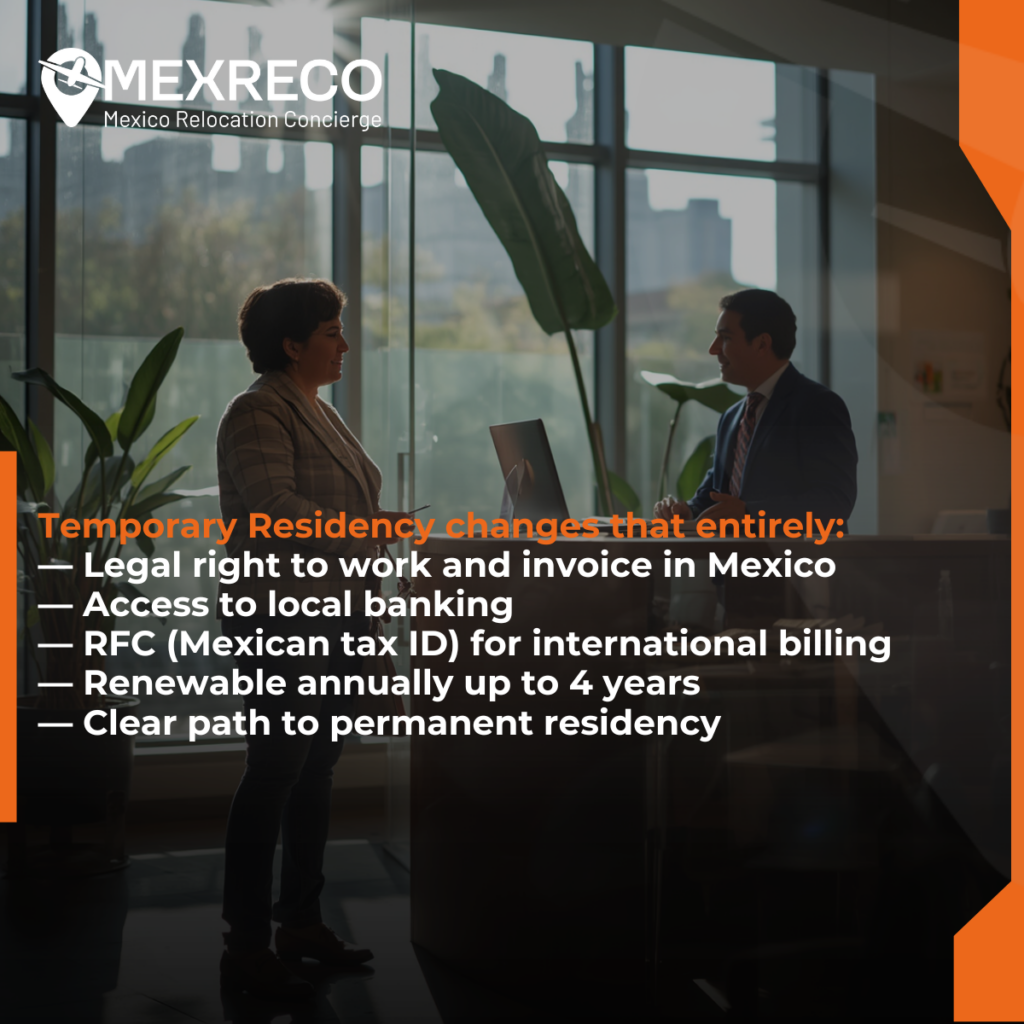
- Valid for 1 year, renewable annually up to 4 years.
- Authorizes the holder to live and work in Mexico.
- Grants access to local banking and the ability to obtain an RFC.
- Can be obtained via income proof, savings/assets, or as a dependent family member.
- Must be initiated at a Mexican consulate in your home country before arrival.
- Opens the path to Permanent Residency after 4 consecutive renewals.
Income thresholds for digital nomads:
To qualify via the income route, you need to demonstrate consistent monthly income meeting INM’s minimum threshold — approximately $1,500–$2,200 USD/month depending on current exchange rates and the annual update to the formula. Many mid-level freelancers and remote workers meet this threshold comfortably.
If your income varies month-to-month (common for freelancers), you can also qualify via savings — demonstrating a bank balance approximately equivalent to 12 months of the minimum income requirement.
The Legal and Financial Difference:
Between Tourist Status and Residency
On Tourist Permit (FMM) Max 180 days — no extension from inside Mexico Cannot legally perform paid work Cannot open Mexican bank account Cannot obtain RFC (tax ID) Cannot invoice from Mexico No path to residency from inside Mexico Exit required before permit expires | With Temporary Residency Valid 1 year, renewable to 4 years Full right to live and work Can open Mexican bank account Can obtain RFC and invoice from Mexico Legal fiscal presence established Path to Permanent Residency No need to exit and re-enter |
The practical difference is significant. With Temporary Residency, you can operate your professional life from Mexico with clarity — opening accounts, invoicing clients, building credit history, and establishing a stable, legal foundation for your stay.
How to Get Your RFC as a Digital Nomad in Mexico
The RFC (Registro Federal de Contribuyentes) is Mexico’s tax identification number. It is required for:
- Opening a Mexican bank account.
- Receiving payments from Mexican clients or platforms.
- Invoicing services (emitting facturas) if you work with Mexican companies.
- Filing taxes in Mexico if you become a tax resident.
To obtain an RFC, you need:
1.- A valid immigration document (Temporary or Permanent Residency card).
2.- A Mexican address (proof of address in Mexico).
3.- A CURP number (unique population registry code — issued with your residency card).
The RFC is obtained through the SAT (Servicio de Administración Tributaria), Mexico’s tax authority. The process can be done online or at a SAT office. A Mexican accountant or tax advisor familiar with expat filings can make this process significantly faster and less stressful.
Can You Open a Bank Account in Mexico as a Foreigner?
Standard requirements are:
- Temporary or Permanent Residency card (not a tourist permit).
- RFC from SAT.
- Proof of address in Mexico.
- Passport.
Major Mexican banks include BBVA Bancomer, Banamex (Citigroup), Santander México, Banorte and HSBC México. Each has different requirements and service levels for foreign residents.
In the short term, before opening a Mexican account, international solutions work well:
- Wise (TransferWise): Excellent for receiving payments in multiple currencies and spending in pesos with favorable exchange rates.
- Charles Schwab: US bank account with unlimited ATM fee reimbursements globally — popular among US-based nomads.
- Revolut and N26: Options for European-based nomads.
The Most Common Mistakes Digital Nomads Make with Mexican Immigration
:
- Assuming 180 days can be extended from inside Mexico: It cannot. When your FMM expires, you must leave the country before re-entering. Overstaying has real consequences.
- Doing ‘visa runs’ as a long-term strategy: Leaving and re-entering to reset the tourist permit is a common practice, but it’s not a sustainable legal strategy. Immigration officers can and do deny re-entry to people who appear to be living in Mexico without proper residency.
- Invoicing from Mexico without an RFC: If you’re sending invoices or receiving payments that reference Mexican fiscal activity without a proper RFC and tax structure, you’re exposing yourself to SAT scrutiny.
- Ignoring tax implications: If you spend 183 days or more in Mexico in a calendar year, you may be considered a tax resident by Mexican law — regardless of where your income comes from. This requires careful planning, not avoidance.
- Waiting for a problem before getting professional advice: The time to address your immigration status is before it becomes an issue, not after you’ve received a notice or had an entry denied.
How MEXRECO Helps Digital Nomads Regularize Their Status in Cancún
At MEXRECO we work with digital nomads and remote professionals who want to live in Cancún with legal clarity. Our role is to take the complexity out of the process and make sure every piece of your relocation structure is in place.
For digital nomads, this typically includes:
1.- Immigration assessment: Evaluating your current status and recommending the best pathway to Temporary Residency based on your income profile.
2.- Consular appointment guidance: Preparing your documentation package for the consulate application in your home country.
3.- RFC and banking setup: Connecting you with tax advisors and banking specialists to establish your fiscal and financial foundation in Mexico.
4.- Housing support: Helping you find a stable, legal rental arrangement in Cancún that fits your lifestyle and work needs.
5.- Tax coordination: Connecting you with an accountant experienced in expat and digital nomad tax situations — both Mexican and bilateral treaty implications.
Living in Cancún as a digital nomad is genuinely one of the best quality-of-life decisions you can make. Doing it with the right legal structure makes it sustainable — not just exciting for 6 months.
Ready to build your legal foundation in Cancún? Let’s start with a free consultation.
Q: Can digital nomads legally work from Mexico on a tourist visa?
A: Legally, Mexico’s tourist permit (FMM) does not authorize work activities, even for remote workers paid by foreign companies. Working from Mexico on a tourist permit is technically in a legal grey zone. For digital nomads who plan to stay more than 6 months and want a clear legal foundation, Temporary Residency is the correct immigration status.
Q: Does Mexico have a digital nomad visa?
A: Mexico does not currently have a visa specifically called a ‘digital nomad visa.’ However, Temporary Residency is the appropriate legal status for remote workers who want to live and work from Mexico for more than 180 days. It authorizes residence and work activities, enables banking and tax registration, and is renewable annually.
Q: How long can I stay in Mexico as a digital nomad without residency?
A: Without residency, you can stay up to 180 days on a tourist permit (FMM). This permit cannot be extended from inside Mexico — you would need to leave and re-enter to receive a new one, though immigration officers have discretion to deny re-entry if they determine you are attempting to live in Mexico without proper residency.
Q: What is an RFC and do digital nomads in Mexico need one?
A: The RFC (Registro Federal de Contribuyentes) is Mexico’s federal tax identification number. Digital nomads who want to open a Mexican bank account, receive payments from Mexican sources, or invoice Mexican clients need an RFC. It requires Temporary or Permanent Residency to obtain. Having an RFC does not automatically create a Mexican tax obligation — that depends on your tax residency status.
Q: Do I pay taxes in Mexico as a digital nomad?
A: If you spend 183 days or more in Mexico in a calendar year, you may be considered a tax resident under Mexican law, regardless of where your income originates. This is a situation that requires professional tax advice — ideally before you reach that threshold — to understand your obligations under Mexican tax law and any applicable tax treaties between Mexico and your home country.
Q: Can I open a bank account in Mexico as a digital nomad?
A: Yes, once you have Temporary Residency and an RFC. Opening a Mexican bank account on a tourist permit is not possible at most major banks. In the interim, international solutions like Wise or Charles Schwab are practical for daily transactions and ATM withdrawals in Mexico.
Q: What are the best neighborhoods in Cancún for digital nomads?
A: Popular areas for digital nomads in Cancún include Puerto Cancún (modern, walkable, close to coworkings), Cancún Centro (local character, affordable, central), and the Zona Hotelera (ocean-facing but more expensive). Many nomads also base themselves nearby in Playa del Carmen or Tulum, which have strong nomad communities and coworking infrastructure.