
Thinking About Moving to Mexico? Read This Before You Do Anything Else (Complete Guide for Cancún)
Thinking About Moving to Mexico? Read This Before You Do Anything Else
You’ve done the research. You’ve seen the photos. Maybe you’ve even visited. And now Cancún feels less like a vacation destination and more like a real possibility — a place where your next chapter could actually begin.
That feeling is not a coincidence. Thousands of Americans, Canadians and Europeans are making exactly this move every year, drawn by a combination of warm weather, world-class beaches, accessible healthcare, a thriving international community, and a cost of living that lets a pension or remote income stretch much further than back home.
But here’s what most people discover too late: moving to another country is not a trip. It’s a structured transition involving legal status, financial decisions, housing, healthcare, banking, and cultural adaptation — all at once, all interconnected, all with consequences if done in the wrong order.
This guide exists to make sure that doesn’t happen to you.
Why Cancún? The #1 Destination for Expats in Mexico
Mexico receives hundreds of thousands of foreign residents every year, but Quintana Roo — the state where Cancún is located — has quietly become one of the most concentrated expat hubs in the entire country. According to INEGI data, the region is home to over 40,000 foreign-born residents, with Americans and Canadians forming the largest groups, followed by Europeans and an increasingly visible community from South America and Eastern Europe.
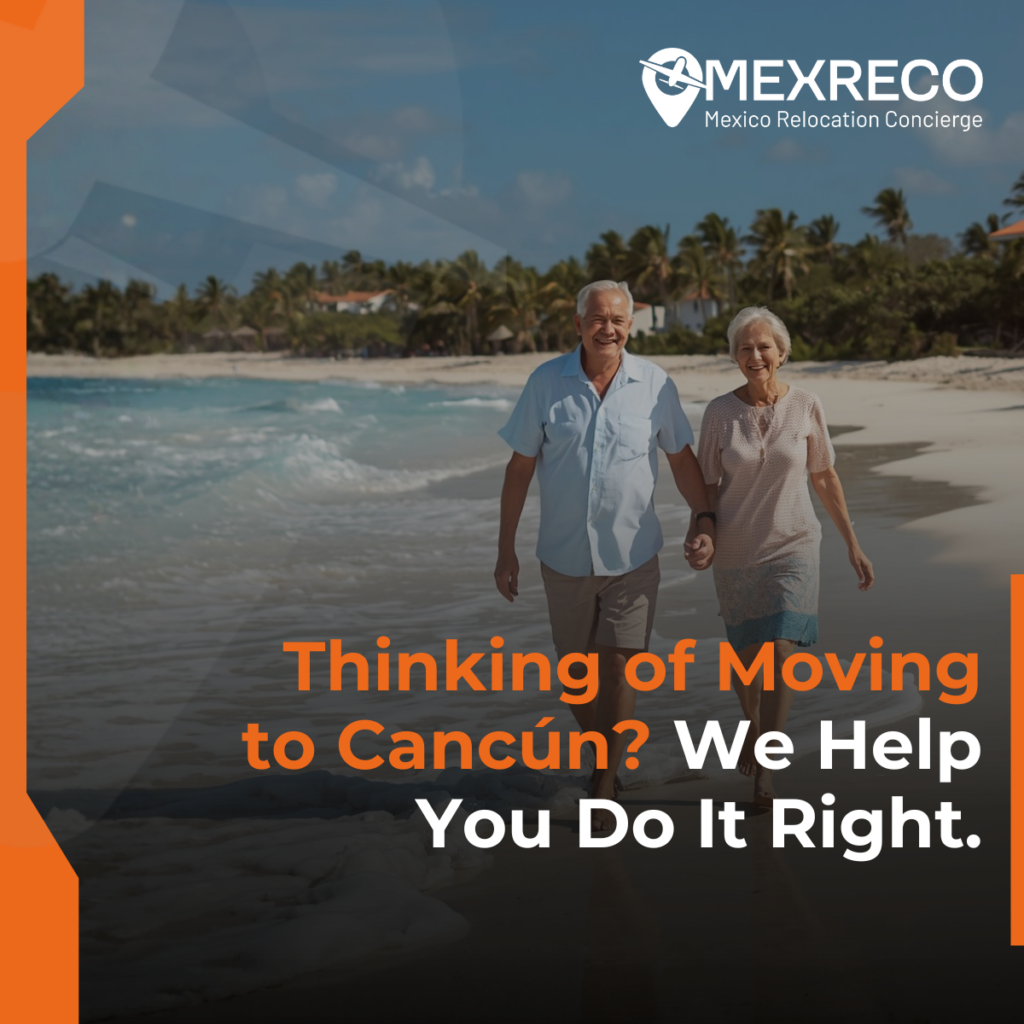
So why Cancún specifically, over other popular destinations like Mexico City, Puerto Vallarta or Mérida?
- Direct international connectivity: Cancún’s airport connects to over 60 cities in North America and Europe, meaning you’re never more than a few hours from home.
- Climate: The Caribbean coast delivers warm, tropical weather year-round — a primary driver for retirees escaping harsh winters.
- Healthcare infrastructure: The city has invested heavily in private medical facilities of international standard, at a fraction of what similar care costs in the US.
- Established expat community: You won’t be arriving somewhere new. You’ll be joining a community that’s been building roots here for decades.
- Cost of living: Depending on your lifestyle, a comfortable monthly budget in Cancún can run USD $1,500–$3,000 — significantly less than comparable cities in the US, Canada or Western Europe.
Mexico — and especially Cancún — is not just an affordable option. It is a genuinely high-quality life, structured around your terms.
The 5 Things You
Must Decide Before You Move
Most relocation mistakes don’t happen on arrival — they happen in the planning stage. Before you book anything, there are five decisions that will define the entire trajectory of your move:
- Your immigration status: Are you coming as a tourist, as a temporary resident, or pursuing permanent residency? Each option has different rights, timeframes and requirements.
- Your income source and tax structure: Where does your income come from? How will it be taxed? Do you need to establish fiscal presence in Mexico?
- Your housing type and location: Temporary rental vs. long-term lease vs. purchase? Central Cancún vs. the Hotel Zone vs. a residential neighborhood like Cancún Centro, Supermanzanas or Puerto Cancún?
- Your healthcare plan: Do you have international health insurance? Is it accepted in Mexico? Do you know which hospitals and specialists are available?
- Your support network: Who will you call when something goes wrong? Who will review your rental contract? Who will help you navigate a government office in Spanish?
These five questions don’t have universal answers — they depend on your specific situation. But they all need answers before you move, not after.
Visa or Residency? Understanding Your Legal Options
One of the most misunderstood aspects of moving to Mexico is the difference between arriving as a tourist and establishing legal residency. Many people — especially those planning to retire or work remotely — arrive on a tourist permit (called FMM) without realizing what it does and does not allow.
Tourist Permit (FMM)
- Allows a stay of up to 180 days.
- Does not authorize employment, invoicing or generating income in Mexico.
- Cannot be extended or renewed from inside Mexico — you’d need to exit and re-enter.
- Overstaying carries fines and can affect future immigration applications.
Temporary Residency
- Valid for one year, renewable up to 4 years.
- Grants the right to live, work and generate income in Mexico.
- Enables you to open a Mexican bank account and obtain an RFC (tax ID).
- Requires proof of income (pension, investments or savings) meeting INM thresholds.
- Must be initiated at a Mexican consulate in your home country before arriving.
Permanent Residency
- No expiration date.
- Full rights to live and work in Mexico indefinitely.
- Available after 4 years of Temporary Residency, or directly for those meeting higher income thresholds.
 Important: Many retirees and digital nomads who arrive on tourist status and stay for months are technically in a legal grey zone. It’s not automatically a crisis — but it’s a situation that needs a clear plan, ideally before you arrive.
Finding Housing in Cancún: What Nobody Tells You
The Cancún rental market is active, competitive, and — if you’re not careful — full of traps for newcomers. Here’s what the real estate listings and expat Facebook groups won’t tell you:
- Prices are often listed in USD but payable in pesos at the current exchange rate. This can work in your favor — or against you — depending on timing.
- Short-term furnished rentals (1–3 months) are significantly more expensive per month than unfurnished long-term leases. Platforms like Airbnb are useful for landing visits, not for permanent living.
- Rental contracts in Mexico are governed by local law and can include clauses that are unusual or unfavorable to foreign renters. Always have a contract reviewed by a local attorney before signing.
- Many neighborhoods have very different characters. The Hotel Zone (Zona Hotelera) is tourist-heavy and expensive. Cancún Centro offers more local character and lower rents. Puerto Cancún and Residencial Cumbres are popular with expat families. Each has trade-offs worth understanding.
- Utilities — water, electricity (CFE), internet — are typically not included in rent and can add $150–$300/month depending on your usage (air conditioning is the biggest factor in the tropics).
Cost of Living
A realistic monthly budget for a comfortable life in Cancún:
Category | Estimated Monthly Cost (USD) |
Rent (1-2BR apartment, residential area) | $600 – $1,200 |
Groceries and dining | $300 – $600 |
Utilities (electricity, water, internet) | $150 – $300 |
Private health insurance | $100 – $400 |
Transportation | $80 – $200 |
Leisure, dining out, entertainment | $200 – $500 |
TOTAL | $1,430 – $3,200 |
Why Most Expats Regret Not Having a Relocation Guide
There’s a pattern we see constantly. Someone plans a move to Cancún on their own — googling, asking in Facebook groups, piecing together information from YouTube videos and blog posts of uncertain vintage. They arrive with excitement, encounter a problem (a confusing rental contract, an expired tourist permit, a healthcare emergency with no established provider), and scramble to find solutions in an unfamiliar country, in a second language, under pressure.
The information is out there. But it’s scattered, often outdated, and rarely tailored to your specific situation. What most people discover they actually needed was not more information — it was a guide.
Someone who knows the system. Who has seen these situations before. Who can review your documents, connect you with vetted specialists, and be available when something unexpected happens.
How MEXRECO Works: Your Cancún Relocation Concierge
MEXRECO was built specifically to fill that gap. We are a relocation concierge service based in Cancún, working exclusively with retirees, digital nomads and expat families who want to establish themselves in Mexico correctly — from day one.
We don’t replace attorneys, accountants or real estate agents. We coordinate them. We are your single point of contact, making sure that every part of your relocation moves in the right direction, at the right time, with the right professionals.
Our process is straightforward:
1.- Initial consultation: We listen to your situation, objectives, timeline and concerns.
2.- Personalized relocation plan: We design a clear roadmap tailored to your profile.
3.- Specialist activation: We connect you with vetted attorneys, tax advisors, healthcare providers and real estate professionals from our trusted network.
4.- Ongoing support: We guide you throughout the process — before arrival, on arrival, and during your first months of establishment.
At MEXRECO, our goal is simple: turn uncertainty into clarity. You make the decision to move. We make sure you do it right.
Q: Is it safe to move to Cancún, Mexico?
A: Cancún is considered one of the safer cities in Mexico for expats and foreign residents. The tourist and residential zones have a strong security infrastructure, and the established expat community of over 40,000 foreign residents in Quintana Roo is a testament to the quality of life the city offers. As in any city, awareness of your surroundings and choosing the right neighborhood are key factors.
Q: What is the first step to moving to Mexico legally?
A: The first step is determining which immigration status is right for your situation: tourist permit (FMM), Temporary Residency, or Permanent Residency. For stays longer than 180 days or if you plan to work or retire in Mexico, Temporary Residency is typically the starting point. This process must be initiated at a Mexican consulate in your home country before arriving.
Q: How much money do you need to move to Cancún?
A: A comfortable monthly budget in Cancún ranges from approximately USD $1,500 to $3,200, depending on your housing choices and lifestyle. This includes rent, groceries, utilities, healthcare insurance and transportation. The cost of living in Cancún is significantly lower than comparable cities in the US, Canada or Western Europe.
Q: Can I move to Mexico without speaking Spanish?
A: Yes. Cancún has a large English-speaking population, especially in residential and service areas popular with expats. Many professionals — doctors, attorneys, real estate agents — speak English. That said, having local support when navigating government offices and legal processes is strongly recommended.
Q: What is MEXRECO and how can it help me move to Mexico?
A: MEXRECO is a relocation concierge service based in Cancún that guides retirees, digital nomads and expat families through every step of the relocation process. We coordinate attorneys, tax advisors, healthcare providers and real estate professionals so you have a single point of contact and a clear, personalized plan from day one.
Q: How long does it take to move to Mexico and get residency?
A: The Temporary Residency process typically takes 4–8 weeks from the initial consular appointment to receiving your residency card in Mexico. The overall relocation timeline — finding housing, setting up banking, healthcare and daily life — varies by individual, but with proper planning most people feel established within 60–90 days of arrival.
Q: Do I need health insurance to live in Mexico?
A: While Mexico does not legally require foreigners to have health insurance, it is strongly recommended. Your home country’s insurance almost certainly does not cover extended stays abroad. International health insurance plans (Cigna Global, Aetna International, Allianz) or local Mexican private insurance are your main options and should be arranged before arriving.